Working Days and Hours 2026 - Estonia
For Estonia in 2026, this Monday-to-Friday planning calendar gives 252 days and 2,016 hours at 8 hours per day, after the included public holidays. It assumes those holidays are not worked and excludes personal leave and company closures.
Sandtime.io editorial team ·
Complete guide to working hours, public holidays, and annual leave in Estonia for 2026
Monthly working days and hours 2026
For Estonia in 2026, this Monday-to-Friday planning calendar gives 252 days and 2,016 hours at 8 hours per day, after the included public holidays. It assumes those holidays are not worked and excludes personal leave and company closures.
Monday-Friday; included holidays not worked; daily hours stated in the guide; no personal leave or company closures deducted.
The Estonian reference lists national and public holidays. Employers generally shorten the working day immediately before New Year, Independence Day, Victory Day and Christmas Eve by three hours. This full-day calendar does not apply those shortened-day reductions, so its annual hours are a partial planning baseline, not the Estonian statutory total. The holiday dates themselves follow the current law.
On a small screen, scroll the table sideways to see every column. With a keyboard, focus the table region and use the arrow keys.
| Month | Planned working days | Working hours | Holidays reducing the total |
|---|---|---|---|
| January 2026 | 21 | 168 | 1 |
| February 2026 | 19 | 152 | 1 |
| March 2026 | 22 | 176 | 0 |
| April 2026 | 21 | 168 | 1 |
| May 2026 | 20 | 160 | 1 |
| June 2026 | 20 | 160 | 2 |
| July 2026 | 23 | 184 | 0 |
| August 2026 | 20 | 160 | 1 |
| September 2026 | 22 | 176 | 0 |
| October 2026 | 22 | 176 | 0 |
| November 2026 | 21 | 168 | 0 |
| December 2026 | 21 | 168 | 2 |
| Total | 252 | 2,016 | 9 |
The accessible table contains the same figures.
Working hours in January 2026
In January 2026, the calendar gives 21 working days and 168 hours for the selected schedule, after deducting 1 included holidays on working weekdays.
Working hours in February 2026
In February 2026, the calendar gives 19 working days and 152 hours for the selected schedule, after deducting 1 included holidays on working weekdays.
Working hours in March 2026
In March 2026, the calendar gives 22 working days and 176 hours for the selected schedule, after deducting 0 included holidays on working weekdays.
Working hours in April 2026
In April 2026, the calendar gives 21 working days and 168 hours for the selected schedule, after deducting 1 included holidays on working weekdays.
Working hours in May 2026
In May 2026, the calendar gives 20 working days and 160 hours for the selected schedule, after deducting 1 included holidays on working weekdays.
Working hours in June 2026
In June 2026, the calendar gives 20 working days and 160 hours for the selected schedule, after deducting 2 included holidays on working weekdays.
Working hours in July 2026
In July 2026, the calendar gives 23 working days and 184 hours for the selected schedule, after deducting 0 included holidays on working weekdays.
Working hours in August 2026
In August 2026, the calendar gives 20 working days and 160 hours for the selected schedule, after deducting 1 included holidays on working weekdays.
Working hours in September 2026
In September 2026, the calendar gives 22 working days and 176 hours for the selected schedule, after deducting 0 included holidays on working weekdays.
Working hours in October 2026
In October 2026, the calendar gives 22 working days and 176 hours for the selected schedule, after deducting 0 included holidays on working weekdays.
Working hours in November 2026
In November 2026, the calendar gives 21 working days and 168 hours for the selected schedule, after deducting 0 included holidays on working weekdays.
Working hours in December 2026
In December 2026, the calendar gives 21 working days and 168 hours for the selected schedule, after deducting 2 included holidays on working weekdays.
Plan hours for your working week
The calculator starts with work from Monday to Friday. Choose the days and daily hours that match your schedule. The result shows hours available after holidays; legal working-time limits depend on the rules for your workplace.
Planning weekdays: Monday, Tuesday, Wednesday, Thursday, Friday; 8 hours/day. Included holidays are assumed not worked; leave and company closures are not deducted.
2,016 hours
On a small screen, scroll the table sideways to see every column. With a keyboard, focus the table region and use the arrow keys.
| Month | Planned working days | Working hours | Holidays reducing the total |
|---|---|---|---|
| January 2026 | 21 | 168 | 1 |
| February 2026 | 19 | 152 | 1 |
| March 2026 | 22 | 176 | 0 |
| April 2026 | 21 | 168 | 1 |
| May 2026 | 20 | 160 | 1 |
| June 2026 | 20 | 160 | 2 |
| July 2026 | 23 | 184 | 0 |
| August 2026 | 20 | 160 | 1 |
| September 2026 | 22 | 176 | 0 |
| October 2026 | 22 | 176 | 0 |
| November 2026 | 21 | 168 | 0 |
| December 2026 | 21 | 168 | 2 |
| Total | 252 | 2,016 | 9 |
The Estonian reference lists national and public holidays. Employers generally shorten the working day immediately before New Year, Independence Day, Victory Day and Christmas Eve by three hours. This full-day calendar does not apply those shortened-day reductions, so its annual hours are a partial planning baseline, not the Estonian statutory total. The holiday dates themselves follow the current law.
How to read the working-hour totals
The Estonian reference lists national and public holidays. Employers generally shorten the working day immediately before New Year, Independence Day, Victory Day and Christmas Eve by three hours. This full-day calendar does not apply those shortened-day reductions, so its annual hours are a partial planning baseline, not the Estonian statutory total. The holiday dates themselves follow the current law.
Count the selected working weekdays, subtract the included holidays that fall on those days, then multiply the remaining days by daily hours. Each holiday date is counted once. A holiday on a day you already exclude does not reduce the total again. Legal reductions and official substitute days follow their own rules.
Local working-calendar questions and examples
Does the Estonian calendar include shortened pre-holiday days?
The Estonian reference lists national and public holidays. Employers generally shorten the working day immediately before New Year, Independence Day, Victory Day and Christmas Eve by three hours. This full-day calendar does not apply those shortened-day reductions, so its annual hours are a partial planning baseline, not the Estonian statutory total. The holiday dates themselves follow the current law.
How does Estonia calculate normal working time?
Estonian full-time work is generally eight hours a day and forty hours per seven days unless shorter hours are agreed. Summarised working-time schedules need period-based checks. Three-hour pre-holiday reductions are separate from full holiday dates; this calculator does not determine the final statutory norm or an employee’s approved schedule.
Are Estonia’s 28 annual leave days working days?
The Estonian minimum annual holiday is generally 28 calendar days. Calendar days include ordinary weekends, so twenty-eight must not be subtracted as twenty-eight Monday-Friday working days. National and public holidays are excluded from the annual leave count; special employee categories can have longer entitlements.
A planning total is not a universal legal annual requirement. Contracts, collective agreements, regions, sectors and actual working schedules can change the result. Record personal leave and company closures separately, and check the country’s working-time rules before using a calendar for payroll.
Working hours 2027: plan the next year
The Estonian reference lists national and public holidays. Employers generally shorten the working day immediately before New Year, Independence Day, Victory Day and Christmas Eve by three hours. This full-day calendar does not apply those shortened-day reductions, so its annual hours are a partial planning baseline, not the Estonian statutory total. The holiday dates themselves follow the current law.
For Estonia in 2027, this Monday-to-Friday planning calendar gives 254 days and 2,032 hours at 8 hours per day, after the included public holidays. It assumes those holidays are not worked and excludes personal leave and company closures.
With the same working days and daily hours, the 2027 preview differs from 2026 by 16 hours. The calendars may cover different holidays; check their scope before using the comparison for a budget.
Open the full 2027 guide for Estonia
Confirmed holiday dates in the 2027 preview
- - New Year’s Day
- - Independence Day
- - Good Friday
- - Easter Sunday
- - Labour Day
- - Whit Sunday
- - Victory Day
- - Midsummer Day
- - Restoration of Independence
- - Christmas Eve
- - Christmas Day
- - Second Day of Christmas
On a small screen, scroll the table sideways to see every column. With a keyboard, focus the table region and use the arrow keys.
| Month | Planned working days | Working hours | Holidays reducing the total |
|---|---|---|---|
| January 2027 | 20 | 160 | 1 |
| February 2027 | 19 | 152 | 1 |
| March 2027 | 22 | 176 | 1 |
| April 2027 | 22 | 176 | 0 |
| May 2027 | 21 | 168 | 0 |
| June 2027 | 20 | 160 | 2 |
| July 2027 | 22 | 176 | 0 |
| August 2027 | 21 | 168 | 1 |
| September 2027 | 22 | 176 | 0 |
| October 2027 | 21 | 168 | 0 |
| November 2027 | 22 | 176 | 0 |
| December 2027 | 22 | 176 | 1 |
| Total | 254 | 2,032 | 7 |
The accessible table contains the same figures.
Working hours in January 2027
In January 2027, the calendar gives 20 working days and 160 hours for the selected schedule, after deducting 1 included holidays on working weekdays.
Working hours in February 2027
In February 2027, the calendar gives 19 working days and 152 hours for the selected schedule, after deducting 1 included holidays on working weekdays.
Working hours in March 2027
In March 2027, the calendar gives 22 working days and 176 hours for the selected schedule, after deducting 1 included holidays on working weekdays.
Working hours in April 2027
In April 2027, the calendar gives 22 working days and 176 hours for the selected schedule, after deducting 0 included holidays on working weekdays.
Working hours in May 2027
In May 2027, the calendar gives 21 working days and 168 hours for the selected schedule, after deducting 0 included holidays on working weekdays.
Working hours in June 2027
In June 2027, the calendar gives 20 working days and 160 hours for the selected schedule, after deducting 2 included holidays on working weekdays.
Working hours in July 2027
In July 2027, the calendar gives 22 working days and 176 hours for the selected schedule, after deducting 0 included holidays on working weekdays.
Working hours in August 2027
In August 2027, the calendar gives 21 working days and 168 hours for the selected schedule, after deducting 1 included holidays on working weekdays.
Working hours in September 2027
In September 2027, the calendar gives 22 working days and 176 hours for the selected schedule, after deducting 0 included holidays on working weekdays.
Working hours in October 2027
In October 2027, the calendar gives 21 working days and 168 hours for the selected schedule, after deducting 0 included holidays on working weekdays.
Working hours in November 2027
In November 2027, the calendar gives 22 working days and 176 hours for the selected schedule, after deducting 0 included holidays on working weekdays.
Working hours in December 2027
In December 2027, the calendar gives 22 working days and 176 hours for the selected schedule, after deducting 1 included holidays on working weekdays.
Which months have the most and least working hours in 2026?
The 2026 calendar for Estonia has a highest monthly total of 184 hours (July). The lowest is 152 hours (February). The difference is 32 hours per full-time person before leave, absences and company closures.
Compare delivery commitments by available hours, not by the number of months. Two equally priced monthly retainers can require different staffing when one month has fewer working days. Keep the calendar assumptions fixed, then adjust for each person’s schedule and approved leave before promising project capacity.
From October’s hours to a realistic project budget
Illustrative example for October 2026: start with 176 hours, reserve 16 hours for two scheduled days of approved leave and 24 hours for internal work. That leaves 136 hours for project allocation. It is a planning budget, not a promise that every remaining hour is billable or a record of hours actually worked.
Before the month begins, assign capacity to projects. During the month, keep actual project hours separately. At close, compare planned capacity with recorded work and approved absences; explain the differences before preparing client reports. A national calendar cannot replace either the employee’s schedule or the project record.
Understand billable utilization · Plan project staffing with the free capacity template · Use approved timesheets for client billing
2026 versus 2027: compare the hours month by month
An unchanged annual total can hide a different monthly workload. Compare matching months before reusing a staffing or delivery budget for 2027. This table uses the same daily hours and weekday assumptions in both years; regional and employer-specific calendars still need their own adjustments.
On a small screen, scroll the table sideways to see every column. With a keyboard, focus the table region and use the arrow keys.
| Month | 2026 | 2027 | Change in hours |
|---|---|---|---|
| January | 168 | 160 | -8 |
| February | 152 | 152 | 0 |
| March | 176 | 176 | 0 |
| April | 168 | 176 | 8 |
| May | 160 | 168 | 8 |
| June | 160 | 160 | 0 |
| July | 184 | 176 | -8 |
| August | 160 | 168 | 8 |
| September | 176 | 176 | 0 |
| October | 176 | 168 | -8 |
| November | 168 | 176 | 8 |
| December | 168 | 176 | 8 |
| Total | 2,016 | 2,032 | 16 |
See the assumptions and confirmed dates for 2027 · Calculate a different period or working week
Free templates for planning and recording hours
Download editable spreadsheets or printable PDFs without registration. Keep calendar capacity, leave and actual time records separate.
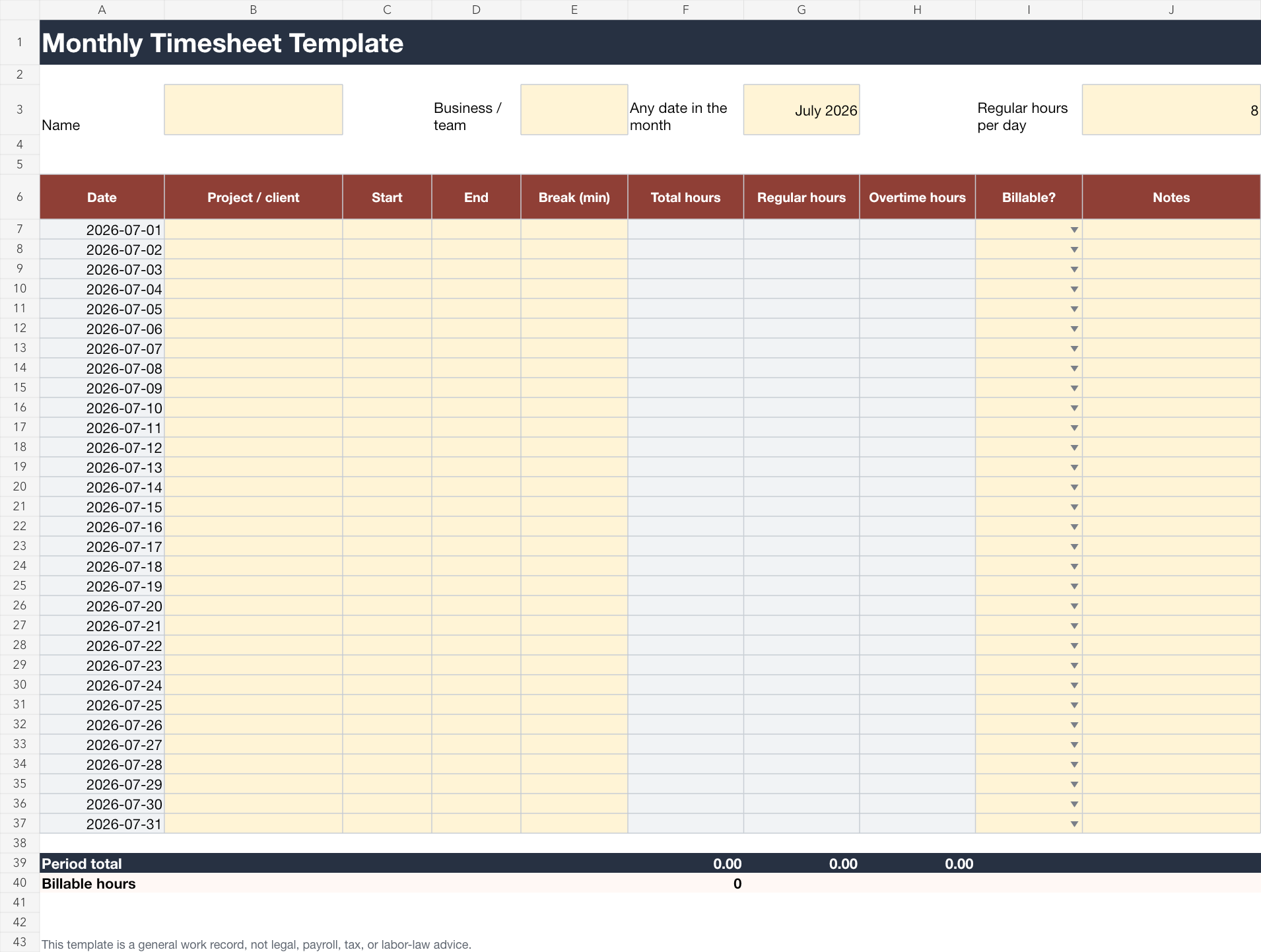
Monthly timesheet
Record actual hours separately from the calendar’s planned total.
Download Excel · Download PDF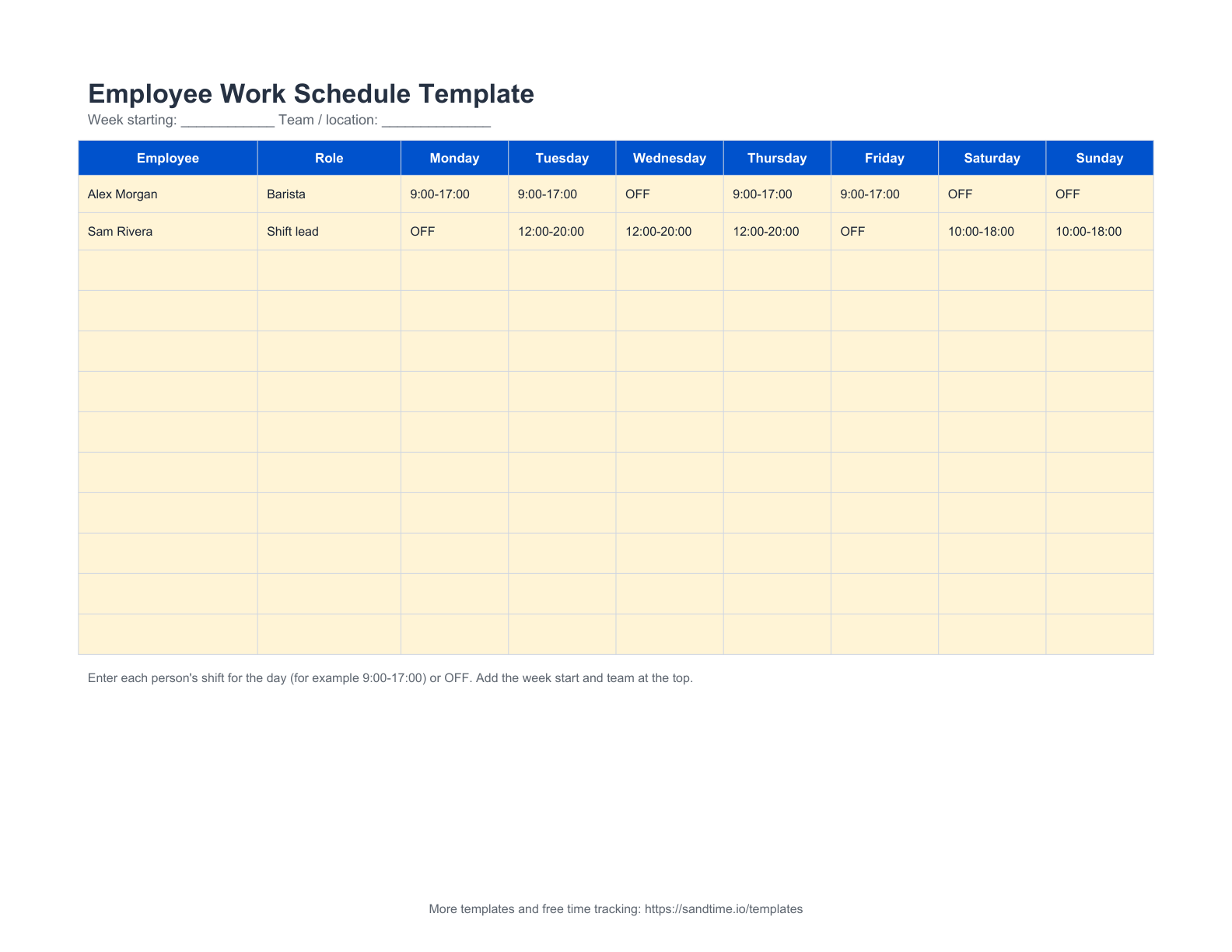
Work schedule
Turn monthly capacity into a team schedule and record company days off.
Download Excel · Download PDF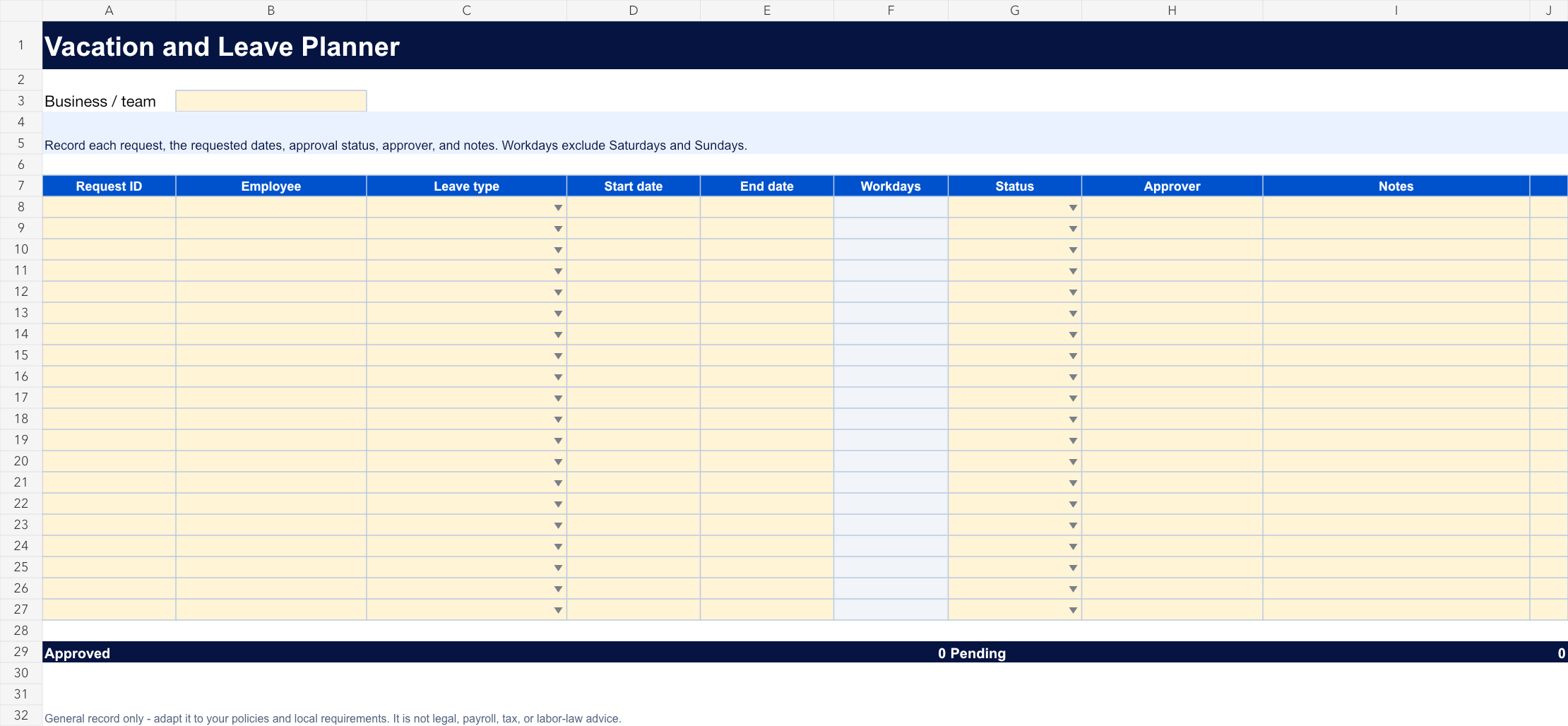
Vacation and leave tracker
Account for personal leave before assigning work to a project.
Download Excel · Download PDF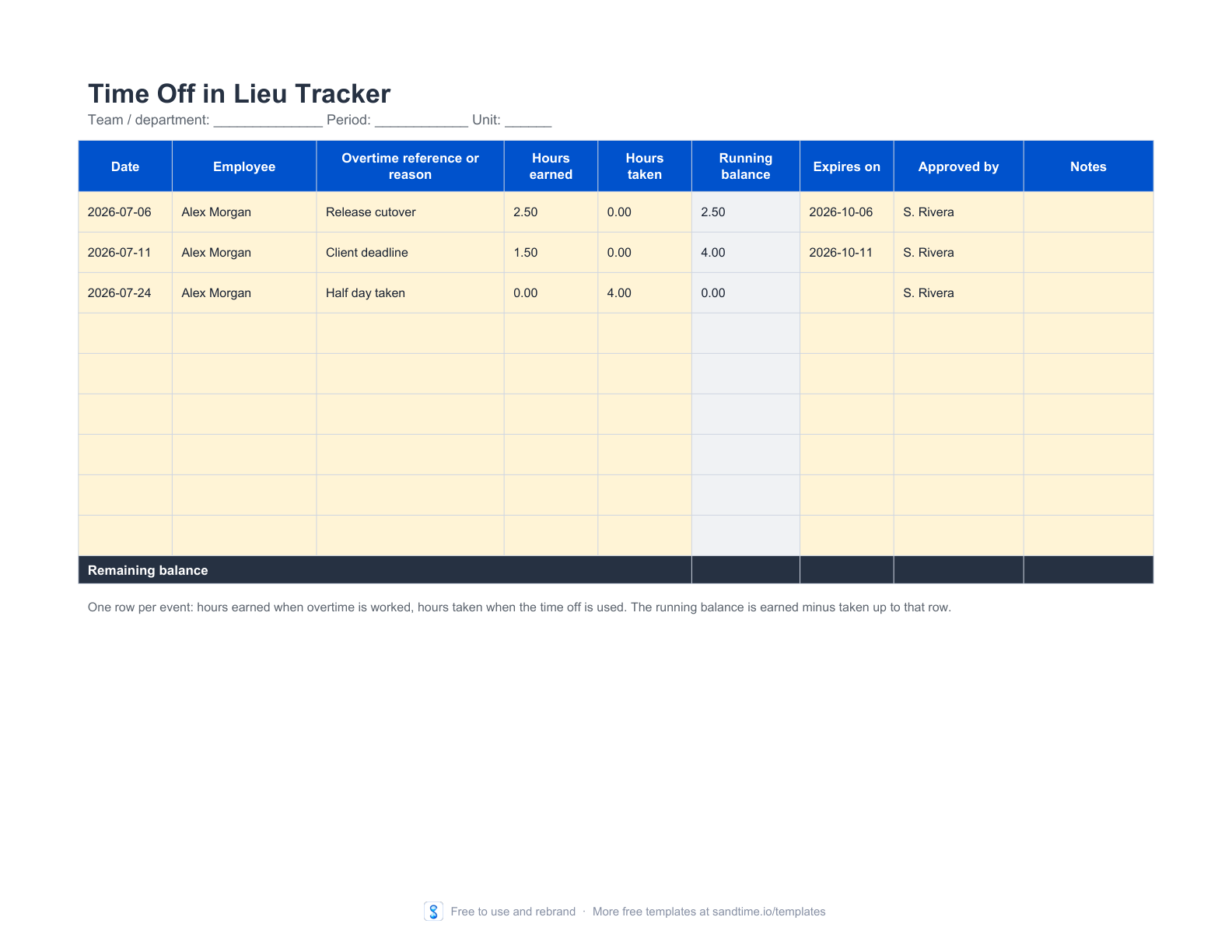
Time off in lieu tracker
Keep a record of granted compensating leave and its remaining balance.
Download Excel · Download PDFFrom the calendar to reliable time records
A calendar tells you how many hours can be planned. A time record tells you which project used them. Review the actual hours before reporting or billing.
Working Hours and Leave in Estonia 2026
Working week used in calculations
Monday to Friday. Edit working weekdays in the calculator; legal limits and actual schedules are separate.
- 8 hours per day
- 5 days per week
- 40 hours per week
Estonian full-time work is generally eight hours a day and forty hours per seven days unless shorter hours are agreed. Summarised working-time schedules need period-based checks. Three-hour pre-holiday reductions are separate from full holiday dates; this calculator does not determine the final statutory norm or an employee’s approved schedule.
Annual Leave Entitlement
28 calendar days
The Estonian minimum annual holiday is generally 28 calendar days. Calendar days include ordinary weekends, so twenty-eight must not be subtracted as twenty-eight Monday-Friday working days. National and public holidays are excluded from the annual leave count; special employee categories can have longer entitlements.
Monthly Averages
- 21.0 working days/month
- 168.0 working hours/month
Public Holidays in Estonia 2026
The stated calendar for Estonia lists 12 holidays in 2026, with 9 falling on weekdays. See full public holidays list
The Estonian reference lists national and public holidays. Employers generally shorten the working day immediately before New Year, Independence Day, Victory Day and Christmas Eve by three hours. This full-day calendar does not apply those shortened-day reductions, so its annual hours are a partial planning baseline, not the Estonian statutory total. The holiday dates themselves follow the current law.
Understanding Holiday Types
Different countries use different terminology for non-working days. Here is what each term means for workforce planning.
Public Holidays
Public holidays listed in the country’s calendar. Check the country guide for the rules on time off, holiday pay and regional differences.
Federal Holidays
Holidays listed in a federal calendar. Check which government offices and employers the calendar covers before applying it to a private workplace.
Bank Holidays
Days when banks and financial institutions are closed. In the UK, this term is synonymous with public holidays. Important for payroll processing and payment schedules.
Observances
Notable dates that are not official days off. Examples include Earth Day or Mother’s Day. These do not affect work schedules unless an employer chooses to recognize them.
| Date | Day | Holiday | |
|---|---|---|---|
| Thu, Jan 1 | Thursday | New Year’s Day | |
| Tue, Feb 24 | Tuesday | Independence Day | |
| Fri, Apr 3 | Friday | Good Friday | |
| Sun, Apr 5 | Sunday | Easter Sunday | Weekend |
| Fri, May 1 | Friday | Labour Day | |
| Sun, May 24 | Sunday | Whit Sunday | Weekend |
| Tue, Jun 23 | Tuesday | Victory Day | |
| Wed, Jun 24 | Wednesday | Midsummer Day | |
| Thu, Aug 20 | Thursday | Restoration of Independence | |
| Thu, Dec 24 | Thursday | Christmas Eve | |
| Fri, Dec 25 | Friday | Christmas Day | |
| Sat, Dec 26 | Saturday | Second Day of Christmas | Weekend |
Turn working days into tracked hours
Sandtime.io is free for unlimited users. Log hours against projects, approve timesheets, and export reports for invoicing.