An Everhour alternative for teams tracking time on its own
Everhour is bought to put time tracking inside Asana, Jira, or Trello, and its free plan leaves those integrations out. Sandtime.io is free for unlimited users with approvals, reminders, and locking included.
Everhour is a time tracking tool built to sit inside project management software, with native integrations for Asana, Jira, Trello, and Basecamp. Its free plan covers up to five seats but excludes those integrations, and the paid plan starts at a five-seat minimum. Visit Everhour website
Best for teams that bill against time and need trust
Sandtime.io fits agencies, freelancers, consultants, and other service teams that need client-ready reports, project visibility, and cleaner invoicing without the seat tax or surveillance that often comes with legacy trackers.
Sandtime.io vs Everhour
| Feature | Sandtime.io | Everhour |
|---|---|---|
| Free plan size | Free for unlimited users, no minimum | Free for up to 5 seats; the paid plan starts at a 5-seat minimum |
| Asana, Jira, and Trello integrations | Not offered | Paid plan only, and the main reason to choose it |
| Billing, budgets, and invoicing | Invoice-ready reports and exports, free | Paid plan feature |
| Timesheet approvals and locking | Included free | Paid plan feature |
| Multi-currency reporting | Included free, with historical rates | One base currency across reports, budgets, and invoices |
| Employee surveillance | No screenshots or keystroke logging | Optional screenshots on Team plans; no keystroke logging |
| Best fit | Teams that need the timesheet itself to be the system | Teams whose work already lives in Asana, Jira, or Trello |
Why teams switch from Everhour to Sandtime.io
Decide whether embedded tracking matters
Everhour's free plan includes time tracking, projects, tasks, reports, and exports for up to five users. Tracking inside Asana, Jira, or Trello requires a paid plan. Choose it when those integrations are central to your workflow.
No seat minimum to round up to
Everhour's paid plan starts at five seats, so a three-person studio pays for five. Sandtime.io is free for unlimited users with no minimum and no rounding up.
The completion workflow, included
Reminders, one-click approvals from email, and automatic locking of past periods are included free, along with multi-currency reporting and historical rates.
Decide where the timesheet lives
Everhour is a good answer to a specific question: how do we track time without leaving the tool where the work is already described. If that is your question, it is worth paying for. If your projects are not run in Asana or Jira, you are buying a bridge to somewhere you do not work.
Choose Sandtime.io when
The timesheet is the system of record rather than a panel inside something else, and you need reminders, approvals, locking, rates and exports without a per-seat bill.
Keep Everhour when
Your team lives in Asana, Jira, or Trello and would not open a separate tracker. That integration is genuinely the product, and Sandtime.io does not replace it.
Watch the seat minimum
A five-seat minimum means a three-person studio pays for five. Compare the real invoice at your actual headcount rather than the advertised per-seat rate.
Pricing and plan details checked October 5, 2026
On the check date, Everhour’s pricing page listed the Team plan at $10 per seat per month, or $8.50 billed annually, with a five-seat minimum.
Check Everhour's current pricing See Sandtime.io pricing · Everhour's screenshot policy · Everhour's currency documentation
Test the workflow before switching
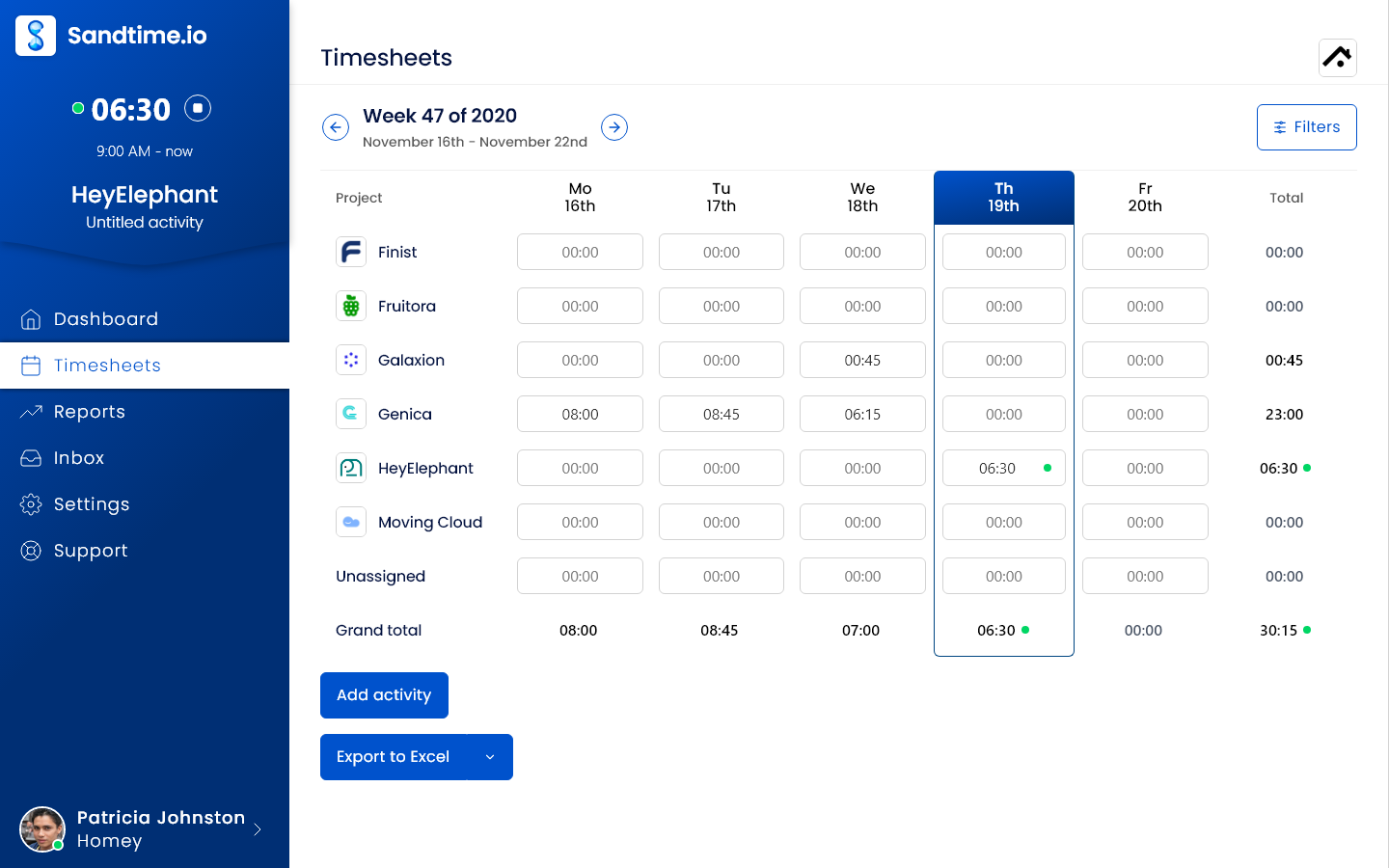
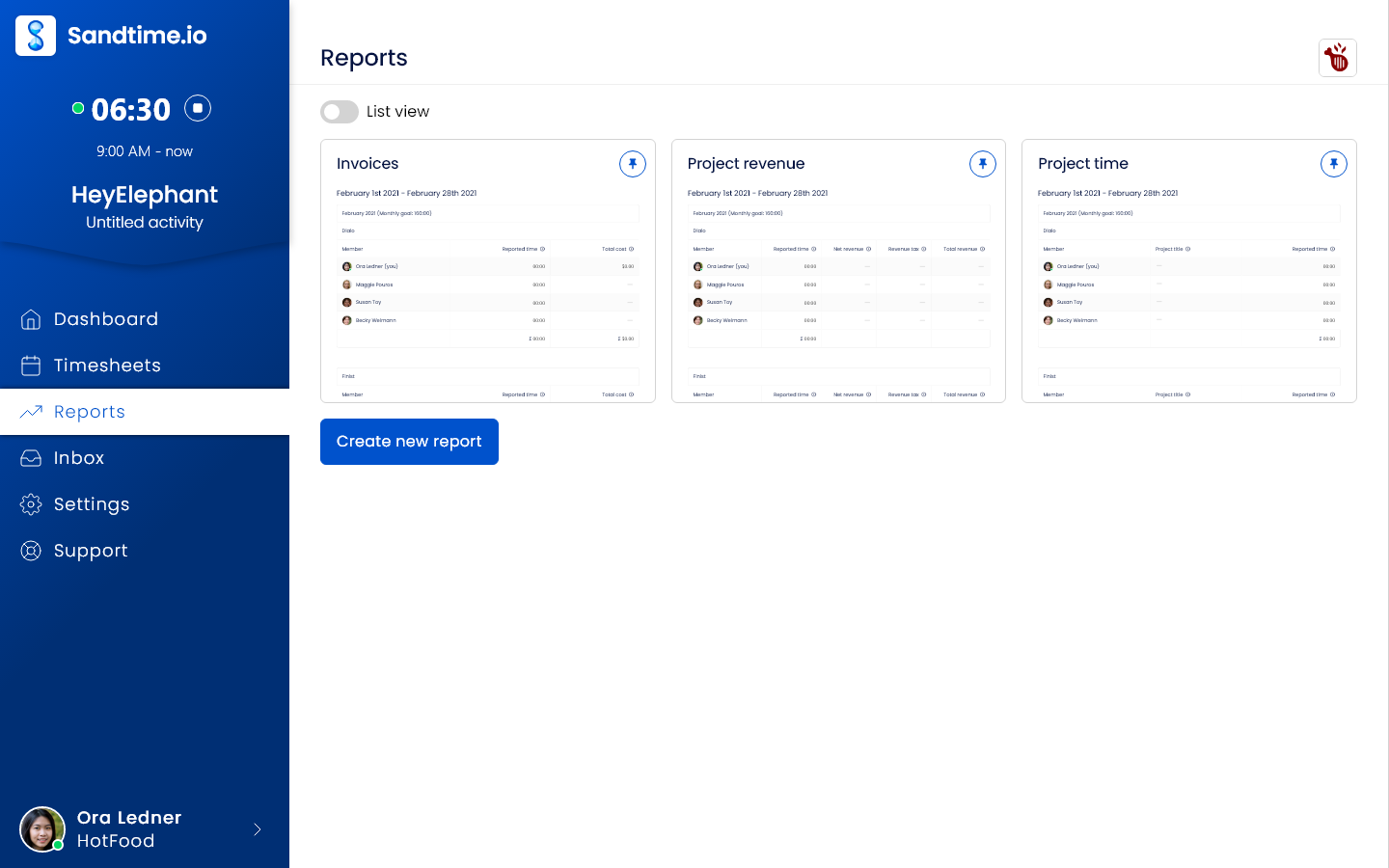
The useful test is whether complete, approved hours reach billing on time. These are real Sandtime.io screens, not mockups of a competitor's product. The screenshots use the English interface; Polish and French interfaces are also available.
Record the work
Use one client project for a complete billing cycle. Track or enter hours yourself; Sandtime.io does not reconstruct work from app or website activity.
Close the week
Submit, approve, and lock the weekly timesheet. Friday email reminders require auto-locking and each user's notification opt-in; they are off by default.
Check the billing handoff
Compare the exported hours and amounts with your existing billing records before switching. Sandtime.io supplies reports and exports, not an invoicing engine.
Keep payroll, attendance, automatic capture, legal billing, and resource planning in the evaluation if your team depends on them. A simpler timesheet tool is not a replacement for those workflows.
See the worked timesheet-to-billing example
Screenshot source: the public Sandtime.io brand kit · Read the approval guide · Read the reminder conditions
Everhour alternative FAQs
Short answers about pricing, migration, and product fit.
Does Sandtime.io embed in Asana, Jira, or Trello?
No. Sandtime.io has no Asana, Jira, or Trello integration. If your team tracks time from inside a project management tool, Everhour does something Sandtime.io does not, and that is the strongest reason to stay.
How do the free plans compare?
Everhour's free plan covers up to five seats but leaves out integrations. Its paid plan starts at a five-seat minimum, so smaller teams pay for seats they do not use. Sandtime.io is free for unlimited users with no minimum.
Is the whole timesheet workflow really free in Sandtime.io?
Yes. Approvals, reminders, locking, reports, exports, multi-currency and historical rates are all included at no cost, with no seat charge and no credit card.
Can Sandtime.io import Everhour data?
Not automatically. Keep Everhour as the historical archive, recreate active clients, projects, people and rates in Sandtime.io, then reconcile one full reporting cycle before cutting over.
Is Everhour still the better choice for some teams?
Yes, when the integration is doing real work. If people log time inside Asana or Jira and would not open a separate tool, Everhour is worth its price and Sandtime.io is the wrong shape.
Comparing something else?
Teams weighing this one usually weigh these too.
Try one project before switching your team
Create a free workspace, record a billing cycle, and check the exported hours against your current records. Keep your existing tool until the workflow fits.